
Carry & travel
Do You Have to Tell a Cop You're Carrying? The 50-State Duty-to-Inform Map
Most duty-to-inform lists online are out of date. We checked all 50 statutes, put them on one map, and built a trip planner for your holiday drive.
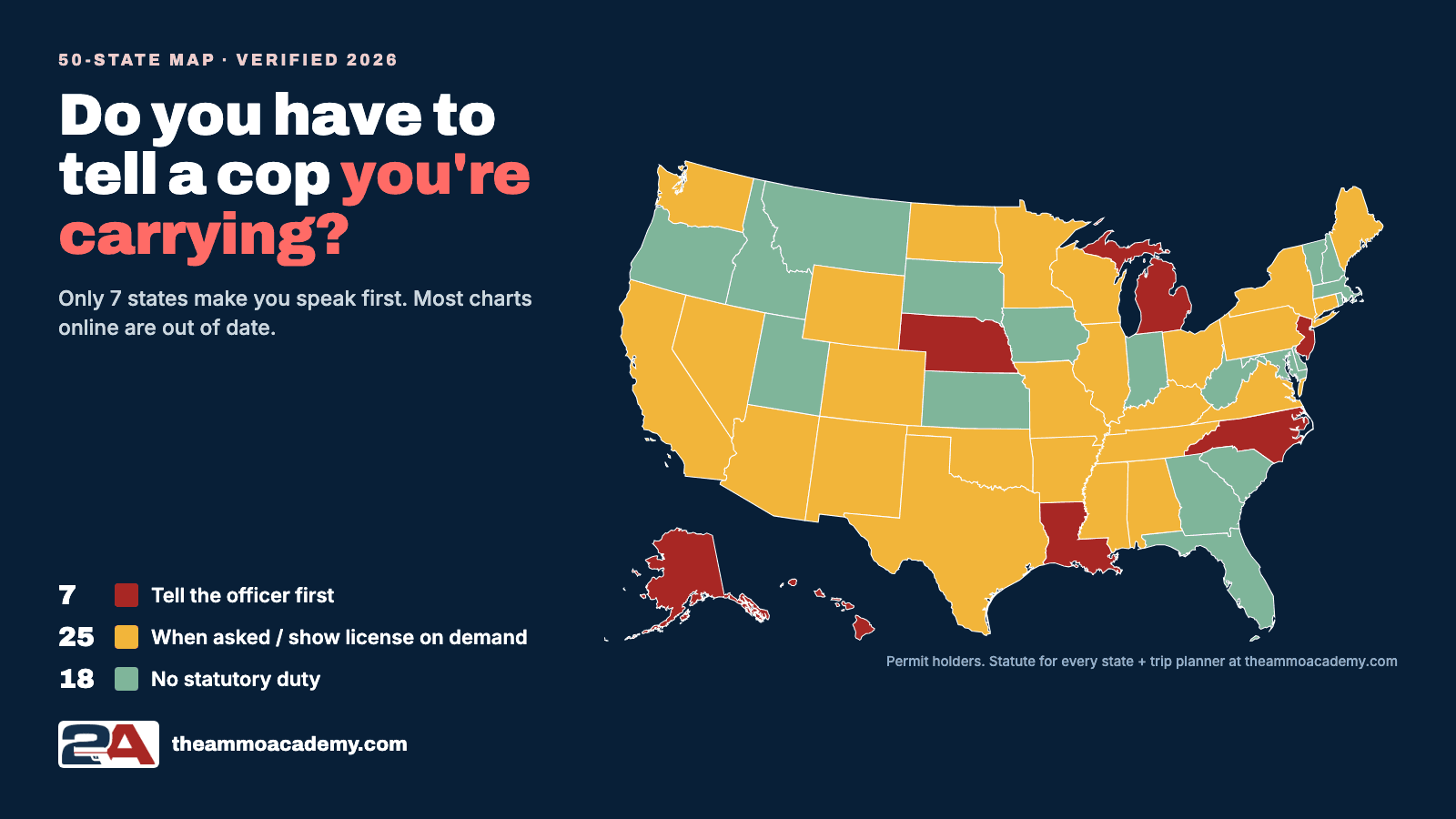
Do you have to tell police you're carrying a gun?
It depends on the state you're in, not the state that issued your permit. In 7 states (Alaska, Hawaii, Louisiana, Michigan, Nebraska, New Jersey and North Carolina) you must tell the officer first. In 25 more, you have to tell the officer or show your license when asked. 18 states have no statutory duty at all. Michigan is a tell-first state: a CPL holder who is carrying must immediately disclose it when stopped.
A lot of you are about to drive to Thanksgiving across two, three, maybe five states. Somewhere on that drive, there's a chance you'll see lights in the mirror. The moment the officer walks up to your window is the worst time to wonder whether that state expects you to say something first.
So we checked. Every state below links to the statute we read. Toggle whether you carry with a permit, then tap every state on your route, including the ones you're only driving through. The planner tells you the strictest rule you'll hit.
7 states require you to speak up first. 25 require it when asked. 18 have no statutory duty.
- Tell the officer first (7)
- Must answer or show license when asked (25)
- No statutory duty (18)
Plan your drive
Tap every state you'll pass through, including the ones you're only driving across. We'll tell you the strictest rule on your route.
Know someone driving armed this holiday? Send them the map.
Embed this map on your website (free)
Gun shops, ranges, instructors and clubs are welcome to use it. Paste this code where you want the map:
Read all 50 states as a list, with citations
- AlabamaWhen asked
- If an officer asks whether you're armed, you must tell them immediately. Applies with or without a permit. Separately, touching a loaded handgun during a vehicle stop is a crime unless the officer directs you to (§ 13A-11-96).
- Ala. Code § 13A-11-95
- AlaskaTell first
- When contacted by a peace officer, you must immediately tell them you're carrying concealed and let them secure the weapon. Applies with or without a permit. Class B misdemeanor.
- AS 11.61.220(a)(1)(A)
- ArizonaWhen asked
- If an officer asks whether you're carrying a concealed weapon, you must answer accurately. Same rule with or without a permit. Class 1 misdemeanor.
- A.R.S. § 13-3102(A)(1)(b)
- ArkansasWhen asked
- Show your license and ID when an officer demands them. State Police rules add that when you're asked for ID, you also tell the officer you're licensed and carrying.
- A.C.A. § 5-73-315; Ark. State Police rule 3.2
- CaliforniaWhen asked
- Show your license, and hand over the firearm for inspection, if an officer demands it. Some county-issued licenses add their own inform condition, so read yours.
- Cal. Penal Code § 26200(a)(9)
- ColoradoWhen asked
- Carry your permit and photo ID and produce both when an officer demands them. No duty to volunteer.
- C.R.S. § 18-12-204(2)(a)
- ConnecticutWhen asked
- Present your permit if an officer who has seen the gun asks for it with reasonable suspicion of a crime. Connecticut doesn't honor out-of-state permits.
- C.G.S. § 29-35(b)
- DelawareNo duty
- We found no statute requiring you to tell an officer or show your license.
- 11 Del. C. § 1441 (no provision)
- FloridaNo duty
- No duty to tell an officer you're armed. You must carry ID and show it (not a license) on demand, with or without a license.
- Fla. Stat. §§ 790.06, 790.013
- GeorgiaNo duty
- No duty to inform since Georgia's 2022 permitless-carry law, which also ended the requirement to carry your license.
- O.C.G.A. § 16-11-137 (rewritten 2022)
- HawaiiTell first
- If you're stopped, or you're a driver or passenger in a stopped vehicle, you must immediately disclose that you're carrying. Added July 2023. Petty misdemeanor.
- HRS § 134-9.2(b)
- IdahoNo duty
- No statutory duty to inform, with or without a license.
- Idaho Code § 18-3302 (no provision)
- IllinoisWhen asked
- If the officer asks, disclose that you're carrying or present your license, tell them where the gun is, and let them secure it for the stop. Applies to nonresidents carrying in a vehicle too.
- 430 ILCS 66/10(h)
- IndianaNo duty
- We found no duty to inform in Indiana law. Permitless carry since July 2022.
- IC 35-47-2 (no provision found)
- IowaNo duty
- No statutory duty. Iowa removed its old carry-and-display rule with permitless carry in 2021.
- Iowa Code § 724.5
- KansasNo duty
- No statutory duty. Kansas dropped its display-on-demand rule when it went permitless.
- K.S.A. 75-7c03
- KentuckyWhen asked
- Licensees must carry the license and display it when an officer asks. $25 noncriminal violation.
- KRS 237.110(15)
- LouisianaTell first
- You must notify any officer who approaches you in an official manner that you have a weapon on you, and submit to a pat-down and temporary disarming. Permit holders risk a 6-month suspension.
- La. R.S. 40:1379.3(I)(2); R.S. 14:95(M)
- MaineWhen asked
- Maine permit holders must show the permit on an officer's demand.
- 25 MRSA §§ 2003(11), 2003-A
- MarylandNo duty
- You must carry your permit, but we found no statute requiring you to tell an officer. Maryland doesn't honor out-of-state permits.
- Md. Code, Pub. Safety § 5-308
- MassachusettsNo duty
- The old show-on-demand language was removed in Massachusetts' 2024 gun law rewrite, and we found no replacement. Confirm locally; Massachusetts licensing is strict.
- M.G.L. c.140 § 129C (as rewritten 2024)
- MichiganTell first
- A CPL holder carrying a concealed pistol, on their body or in the vehicle, must immediately disclose it when stopped. First offense: $500 fine and 6-month CPL suspension. Again within 3 years: $1,000 and revocation.
- MCL 28.425f(3), (5)
- MinnesotaWhen asked
- If an officer asks, you must say whether you're carrying. Carry your permit and photo ID and show both on lawful demand.
- Minn. Stat. § 624.714, subd. 1b
- MississippiWhen asked
- Licensees must display the license and ID on an officer's demand. $25 noncriminal violation.
- Miss. Code Ann. § 45-9-101(1)(b)
- MissouriWhen asked
- Permit holders show the permit and photo ID when an officer asks. Not a crime; a citation up to $35.
- RSMo 571.121.1
- NebraskaTell first
- Anyone carrying concealed must immediately tell a peace officer (or emergency services personnel) who contacts them. Since 2023 this covers permitless carriers. First offense is a misdemeanor; repeat offenses can be a felony.
- Neb. Rev. Stat. § 28-1202.04
- NevadaWhen asked
- Carry your permit and ID and present both if an officer asks. $25 civil penalty.
- NRS 202.3667
- New JerseyTell first
- If stopped while carrying, or traveling with a handgun in the vehicle, you must immediately disclose it and display your permit. Failing to disclose is a fourth-degree crime.
- N.J.S.A. 2C:58-4.4(b)
- New MexicoWhen asked
- Display your license when a peace officer demands it (an administrative rule).
- 10.8.2.16(D) NMAC
- New YorkWhen asked
- Exhibit your license on a peace officer's demand. New York doesn't honor any out-of-state permit.
- N.Y. Penal Law § 400.00(8)
- North CarolinaTell first
- When approached or addressed by an officer, you must disclose that you hold a permit and are carrying, and show the permit and ID if asked. North Carolina's permitless-carry bill had not become law as of our check.
- N.C.G.S. § 14-415.11(a)
- North DakotaWhen asked
- Show your license when an officer asks. If you carry without one, you must tell an officer about the firearm if they ask. $20 noncriminal fee.
- N.D.C.C. § 62.1-04-04
- OhioWhen asked
- Since June 2022 you must disclose that you're carrying if an officer asks (the old 'promptly inform' rule is gone). Same for permitless carriers. Second-degree misdemeanor.
- Ohio R.C. 2923.12(B)(1), 2923.16(E)(1)
- OklahomaWhen asked
- During a stop you must identify that you're armed upon the officer's demand. Applies with or without a license. Citation up to $100.
- 21 O.S. § 1290.8
- PennsylvaniaWhen asked
- Produce your license on a lawful demand by an officer, on foot or in a vehicle.
- 18 Pa.C.S. § 6122(a)
- Rhode IslandNo duty
- We found no statute requiring you to tell an officer or show your license.
- R.I. Gen. Laws ch. 11-47 (no provision)
- South CarolinaNo duty
- No duty to notify since March 2024, per SLED, for permit holders and permitless carriers alike.
- S.C. Code § 23-31-215 (2024 Act 111)
- TennesseeWhen asked
- Display your permit on an officer's demand when the permit is what makes your carry lawful there.
- Tenn. Code §§ 39-17-1351(n), 39-17-1366(e)
- TexasWhen asked
- If an officer asks for your ID while you're carrying, show your handgun license along with it.
- Tex. Gov't Code § 411.205
- UtahNo duty
- No statutory duty. Your permit is linked to your driver license record, so the officer may already know.
- Utah Code 53-5a Part 3 (no provision)
- VermontNo duty
- No statutory duty. Vermont doesn't issue carry permits at all.
- 13 V.S.A. ch. 85 (no provision)
- VirginiaWhen asked
- Carry your permit and photo ID and display both on an officer's demand. $25 civil penalty.
- Va. Code § 18.2-308.01
- WashingtonWhen asked
- Carry your license and display it on an officer's demand. Class 1 civil infraction.
- RCW 9.41.050(1)(b)
- West VirginiaNo duty
- No statutory duty to inform. Permitless carry for adults 21+ since 2016.
- W. Va. Code ch. 61, art. 7 (no provision)
- WisconsinWhen asked
- Display your license and photo ID when an officer asks. Applies to out-of-state licensees too. Up to $25, waived if you show it within 48 hours.
- Wis. Stat. § 175.60(2g)(c)
- WyomingWhen asked
- Carrying under a Wyoming permit, display the permit and ID when a peace officer asks.
- Wyo. Stat. § 6-8-104(b)
The three kinds of duty-to-inform rules
- Tell first (7 states). The law makes you speak up at the start of the contact, before the officer asks. Words like "immediately" or "when approached" are the tell.
- When asked (25 states). You don't have to volunteer it, but you must answer truthfully, or hand over your license, if the officer asks. In most of these states the rule is "display your license on demand."
- No statutory duty (18 states). Nothing in the state's code requires you to tell or show. That doesn't make lying to an officer a good idea, and it doesn't stop an officer from asking.
The states where you have to speak first
If you hold a permit, these seven states expect you to speak up before the officer asks. Plus one twist for people carrying without a permit, below.
- Alaska: anyone carrying concealed must immediately tell an officer who contacts them, permit or not, and let the officer secure the weapon.
- Hawaii: drivers and passengers in a stopped vehicle must immediately disclose (since July 2023).
- Louisiana: notify any officer who approaches you in an official manner, permit or not (permitless carriers since July 2024).
- Michigan: CPL holders must immediately disclose at a stop, on the body or in the car. First miss: $500 and a 6-month CPL suspension.
- Nebraska: anyone carrying concealed must immediately tell an officer, or emergency services personnel, who contacts them.
- New Jersey: immediately disclose if stopped while carrying or with a handgun in the vehicle, and show your permit. Failing to disclose is a fourth-degree crime.
- North Carolina: tell the officer you have a permit and are carrying when approached or addressed.
Most duty-to-inform lists online are out of date
When carrying without a permit changes the rule
Use the toggle above the map. In most permitless-carry states the duty, if there is one, attaches to the permit, so people carrying without one have less to do. Maine is the opposite. A Maine permit holder only has to show the permit on demand, but someone carrying concealed *without* a Maine permit must immediately tell the officer at an arrest, detainment or traffic stop. Alaska, Louisiana and Nebraska apply their tell-first rule to permitless carriers too.
And in states that don't allow permitless carry at all, the map shows them grey. That's not a duty-to-inform question. It's a "can I carry here at all" question, and it's where permit recognition comes in.
What to actually say: a 30-second traffic stop
- 01Pull over somewhere safe, engine off, window down. At night, turn on the dome light.
- 02Hands on the wheel, where they can be seen. Passengers keep their hands visible too.
- 03Say it before you reach for anything. Your license, registration and insurance are usually in the same places as people's guns: pockets, the console, the glove box.
- 04Keep it short and calm. Then let the officer decide what happens next.
- 05Don't touch the gun unless the officer tells you to, and then move slowly and narrate what you're doing.
"Officer, before I reach for anything, I want you to know I have a concealed pistol license and I'm carrying. My pistol is on my right hip. My license is in my wallet. How would you like me to handle this?"
That's it. It tells the officer the two things they care about: where the gun is, and that you aren't going to surprise them. In a when-asked state, you can say exactly the same thing if they ask.
Should you tell the officer even when you don't have to?
That's your decision, and reasonable instructors disagree. What I teach my students is this: pick one habit and use it everywhere. If your habit is to tell first, you'll never get caught out in Michigan, North Carolina or New Jersey because you were in "Ohio mode." In the states where you don't have to speak first, telling the officer is still legal and usually lowers the temperature. What you should never do, anywhere, is lie when you're asked.
Police Encounters While Armed
A short U.S. LawShield online course on exactly this: duty-to-inform rules, what to do with your hands, your license and your firearm, and how to keep a tense stop calm. It's also one of the 12 courses in the Handgun Owner Foundations bundle.
See the courseMichigan drivers: the rule and the penalty
Michigan's rule is in MCL 28.425f. A CPL holder who is carrying a concealed pistol, on their body or in the vehicle, and is stopped by a peace officer must immediately disclose it. A first failure is a state civil infraction with a $500 fine and a 6-month CPL suspension. A second within three years is a $1,000 fine and revocation. That's one of the steepest duty-to-inform penalties in the country for something that takes five seconds to say.
Want to see whether you'd pass? Our Michigan gun law quiz has 12 questions on traffic stops, pistol-free zones and travel.
Before your holiday drive: the 4-item check
- 01Can you carry there at all? Check whether each state honors your permit. Our permit finder and multi-state permit guide start there.
- 02How will you transport it? Federal safe passage has conditions. Read how to transport a gun across state lines before you pack.
- 03What will you say at a stop? Tap your route on the map above.
- 04Is your carry setup secure for six hours in a car seat? A holster that covers the trigger and stays put matters more on a road trip than at home. I carry a Warriorland IWB hybrid holster daily; code THEAMMOACADEMY takes 10% off at Warriorland.
Practice saying it out loud
Knowing the script and saying it with lights behind you are two different things. If you'd like to rehearse a traffic stop with an instructor, including where your hands go and how to answer when you're asked to step out, we can build it into a private lesson in Metro Detroit.
Quick answers
Do I have to tell police I have a gun in my car in Michigan?
Yes, if you're a CPL holder carrying a concealed pistol. MCL 28.425f requires you to immediately disclose it when stopped by a peace officer, whether the pistol is on you or in the vehicle. A first violation is a $500 civil fine and a 6-month CPL suspension.
Is Ohio still a duty-to-inform state?
Not in the old sense. Since June 13, 2022, Ohio no longer requires you to promptly inform an officer. You must disclose that you're carrying if the officer asks, and failing to do so is a second-degree misdemeanor.
Does South Carolina have a duty to inform?
No. South Carolina's 2024 constitutional carry law removed it. SLED's guidance says neither permit holders nor people carrying without a permit have a duty to notify an officer.
Whose rule applies when I travel, my home state's or the state I'm in?
The state you're physically in. A Michigan CPL holder driving through Ohio follows Ohio's rule, and an Ohio resident driving in Michigan follows Michigan's.
This article explains general rules as of the date above and links the statute for every state. It isn't legal advice, and laws change. Before you travel, confirm the current rule for every state on your route with that state's own sources or a lawyer. The Ammo Academy may receive compensation from links to U.S. LawShield courses and Warriorland. It costs you nothing extra.
Keep reading
- How to transport a gun across state lines
Federal safe passage and the four places it stops protecting you
- Traveling armed: the pre-trip guide
Transport rules, duty to inform and prohibited places
- Which permit should you get?
Compare permits by where they're honored
- Michigan gun law quiz
12 questions on traffic stops, pistol-free zones and travel
- Handgun Owner Foundations bundle
12 short courses, including Police Encounters While Armed
Best value: 12 courses, one price
Your permit class covered the basics. Who covered the rest?
Can you say what to do at a traffic stop, where your permit stops counting, and how your firearm must be stored on a road trip? If any of that made you pause, this is your refresher.
$49.99 for all 12, about $4.17 a course
Save at least $59.90 over buying them one at a time at $9.99 each, and Loading & Unloading Handguns is only available here. All 12 are online, 3 to 4 hours in total, on any device, and your progress is saved.
Educational courses from U.S. LawShield. They don't replace your state's licensing requirements.
After the decision
If you carry away from home, who do you call afterward?
Training and permits prepare you for the decision itself. They don't cover what follows a defensive incident, which could happen in a state far from home: investigation, charging decisions, and the civil claim that can arrive much later.
Legal-defense memberships exist for that part. Whether one is worth it to you is a real question, and it's worth understanding before you decide either way.
U.S. LawShield is an independent company. We're one of their instructor partners and may be compensated for referrals.
Sources
- MCL 28.425f — Michigan duty to disclose
Immediate disclosure in (3), penalties in (5)
- Ohio R.C. 2923.12 — disclosure when asked (since June 2022)
- SLED — South Carolina constitutional carry guidance
No duty to notify since March 2024
- Neb. Rev. Stat. 28-1202.04 — Nebraska duty to inform
- N.J.S.A. 2C:58-4.4 — New Jersey (P.L.2022, c.131)
- N.C.G.S. 14-415.11 — North Carolina
- 25 MRSA 2003-A — Maine (carry without a permit)
- 21 O.S. 1290.8 — Oklahoma
- All 50 citations
Open "Read all 50 states as a list" under the map
Last reviewed November 15, 2026. Educational information only. Not legal advice. Firearm laws change, and requirements vary by state, county and issuing authority. Verify current requirements with the issuing authority before you apply.
Keep reading